Tinkers' Construct
Tinkreate
Tinkers' Construct replaces vanilla tools with a modular system: every tool is built from parts, each part's material shapes its stats and grants a passive trait, and tools grow with modifiers over time. Tools never break outright: at 0 durability they simply go dull until repaired. It is one of Tinkreate's two core pillars.
Overview
- Instead of one crafting recipe, every tool is assembled from parts (head, handle, binding…); each part's material sets stats and adds a trait.
- Tools never break: at 0 durability they stop working until repaired, so a well-built tool can last the whole world.
- Tools grow with you: add modifiers (Tinkers' take on enchantments), swap worn parts, and re-forge as you unlock better materials.
- Progression is a metallurgy mini-game: melt ores, cast metal parts, alloy exotic materials, and climb four tiers from wood/stone to netherite-class gear.
- It pairs naturally with Create, Create automates ore processing and lava, Tinkers turns it into the tools you use.
Getting started
You can build complete tools from tier-1 materials with just two blocks, no smelting required.
First workstations
- Part Builder: turns a material + a reusable Pattern into a tool part.
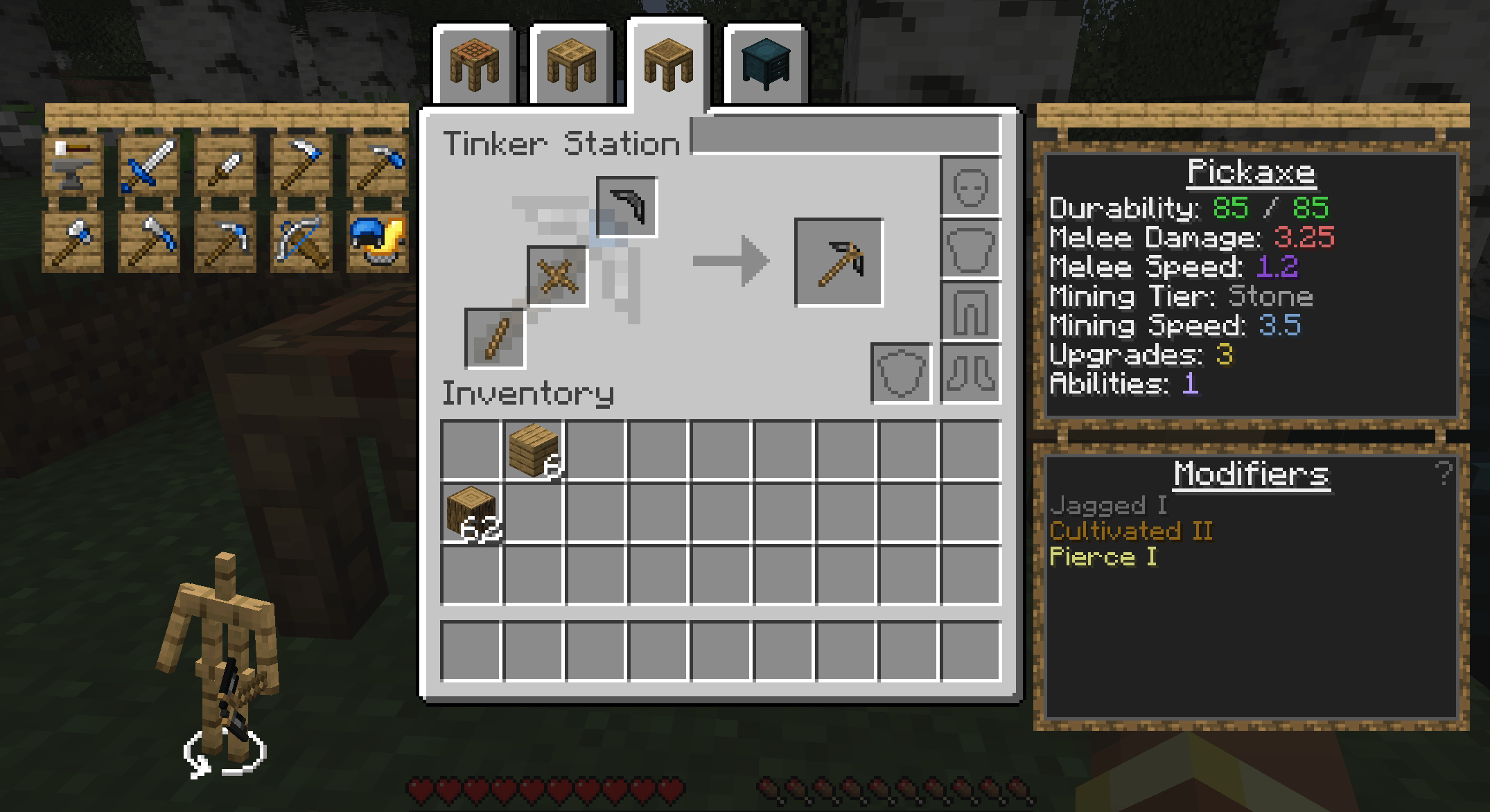
- Tinker Station: slots parts into a finished tool, repairs tools, and applies most modifiers.
Your first tool
A basic pickaxe needs three parts: a pickaxe head, a tool handle, and a tool binding. Build each in the Part Builder (e.g. stone head + wooden handle + wooden binding), drop all three into the Tinker Station, and it assembles the pickaxe. The head sets mining tier, speed, durability and attack; the handle and binding adjust durability/speed and add their own traits.
Tinker Station vs. Tinker's Anvil
- Tinker Station: standard tools (up to ~3 parts); your early-game hub.
- Tinker's Anvil: late-game upgrade for broad tools (sledgehammers, excavators, cleavers, multi-block area tools) and higher-tier modifiers. Built after you have a smeltery.


The Smeltery
The Smeltery is the heart of mid/late Tinkers: it melts ores and metals into fluid, then lets you cast parts and alloy new materials. Lava is its fuel.
Stepping stone, the Melter
Before the full smeltery, build a small Melter from seared bricks. It melts a little ore at a time and is the cheapest way to start casting metal parts.
Building the full Smeltery
- Craft Grout from equal sand + gravel + clay, then smelt it into Seared Bricks: the building block for nearly every smeltery part.
- Lay a 3×3 floor of Seared Bricks (often sunk one block down) and build hollow walls up around it.
- Place a Smeltery Controller in a wall facing inward (cast molten copper over a Seared Heater).
- Add a Seared Tank to hold lava (fuel), a Seared Drain, and mount a Faucet on the outside of the drain.
- Set a Casting Table (parts/ingots) and/or Casting Basin (blocks/large items) under the faucet to catch the pour.
When valid, right-click the controller to open the smeltery UI. Enlarge the box (up to a 7×7 interior) to melt more at once.
Melting & casting
- Drop ores/metals in; with lava fuel they turn to molten fluid (many ores ore-double when melted).
- To cast a part: place a Cast on the table (a gold cast, or a one-use sand cast), pour the matching metal over it, and it solidifies.
- Sand casts are consumed each pour; gold casts are permanent: make gold casts for parts you cast often.
- Fluid math (3.x): 90 mb per ingot, so a metal block is 810 mb and most parts cost a couple ingots.
Alloys
The smeltery automatically mixes molten metals into alloys when the right fluids and ratios are present, the gateway to tier-3 and tier-4 materials. Examples: Manyullyn, Hepatizon, Queen's Slime, Rose Gold, Pig Iron, Slimesteel. The standalone Alloyer can also make alloys for early nether progression.


Materials & tiers
Every part contributes a trait; the head matters most. Materials fall into four tiers:
| Tier | Class | Examples | How to get |
|---|---|---|---|
| 1 | Wood / Stone | Wood, Stone, Flint, Bone, Rock | Part Builder directly, no smelting |
| 2 | Iron | Iron, Copper, Slimewood, Seared Stone | Melter / early smeltery |
| 3 | Diamond | Cobalt, Slimesteel, Pig Iron, Rose Gold | Nether ores / alloying |
| 4 | Netherite | Manyullyn, Hepatizon, Queen's Slime, Blazing Bone | Advanced alloying |
Standout materials
- Cobalt (T3): fast & durable, mines quickly. Found in the Nether.
- Manyullyn (T4): top melee material; very high durability & attack. Alloy cobalt with the netherite line.
- Queen's Slime (T4): strong utility / ability-slot synergy.
- Hepatizon (T4): Momentum-style trait: gets faster the longer you work without stopping.
- Slimewood (T2): flexible; boosts modifier capacity, great for staffs.
- Paper (special): low stats, but its trait grants an extra modifier slot: a deliberate "build for modifiers" pick.
Modifiers
Modifiers are Tinkers' answer to enchantments. Apply them in the Tinker Station (basic) or Tinker's Anvil (advanced) by dropping the modifier item into the tool's slot.
How slots work
- Each tool has limited slots in categories: Upgrade, Ability, Defense, and Slotless.
- Add more slots with a Paper part, the Writable modifier (book + ink), or slot-granting modifiers as you tier up, trading stat quality for enchant capacity.
Most useful modifiers
| Modifier | Apply with | Effect |
|---|---|---|
| Luck | Lapis Lazuli (×3) | Fortune on tools / Looting on weapons |
| Haste | Redstone (up to ~5) | Faster mining & attack speed |
| Sharpness | Quartz | + attack damage |
| Diamond | 1 Diamond | + durability, speed, attack & mining tier |
| Reinforced | Obsidian | Chance to take no durability damage |
| Emerald | 1 Emerald | Durability / stat boost (pairs with Diamond) |
| Soulbound | Nether Star line | Keep the tool on death |
Auto-Smelt, Fiery, Knockback, and Necrotic (lifesteal) are unlocked at the Anvil with rarer ingredients.

Key recipes
Format: result ← ingredients (method). A few exact counts are config-tweakable per pack. In-game EMI is the source of truth for Tinkreate's numbers.
Tinkers' Planner
A client-side companion that lets you preview the stats of any tool built from any parts/materials before you craft it, so you never waste manyullyn.
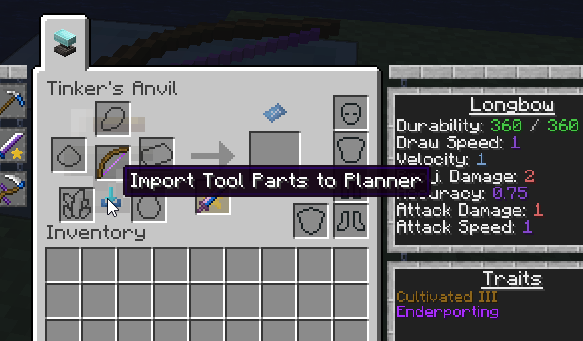
- Adds a blueprint button to the Tinker Station & Anvil screens.
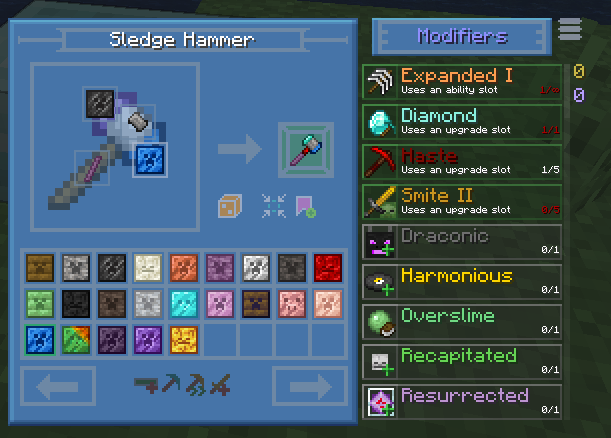
- Draft tools, swap materials, and see resulting stats instantly; sort/compare materials by attribute.
- Add/preview modifiers with real restrictions enforced (sliders for variable ones like Haste).
- Bookmark designs; starred tools can auto-place matching parts from your inventory.
- Entirely client-side, safe to add/remove, no world impact.
Tips & progression
- Build the starter trio first: Part Builder + Tinker Station + a stone/flint pickaxe gets you mining with no metal.
- Don't skip the Melter: it's far cheaper than a full smeltery and casts iron/copper parts early.
- Hoard lava in seared tanks: it's fuel, and effectively infinite if you pump a lava lake (great Create synergy).
- Make gold casts for parts you re-cast often; sand casts are fine for one-offs.
- Plan before you commit: use the Tinkers' Planner to preview a build before spending rare materials.
- Save ability slots: apply cheap stat modifiers (Diamond, Emerald, Reinforced) with raw items, reserve abilities for high-impact effects.
- Paper part = a modifier build: take the stat hit for an extra slot when you want a maxed-out tool.
- Tier up deliberately: stone → iron/copper → cobalt (Nether) → manyullyn / queen's slime.
- Repair, don't rebuild: one good tool can carry the whole world.
Sources
- SlimeKnights, Tinkers' Construct 3 Overview: slimeknights.github.io/docs/gameplay/tinkers-construct-3
- SlimeKnights, What's New (tiers, alloys, fluid values): slimeknights.github.io/docs/whats-new
- SlimeKnights, Modifier recipes: slimeknights.github.io/docs/json/recipes/modifiers
- Tinkers' Construct on CurseForge: curseforge.com/minecraft/mc-mods/tinkers-construct
- Tinkers' Planner on CurseForge: curseforge.com/minecraft/mc-mods/tinkers-planner
- Smeltery construction reference (Fandom): tinkers-construct-3.fandom.com/wiki/Smeltery